About Me

About The Author

Michael Parsons

Michael Parsons is an international educational leader, strategist, and published author with more than twenty five years of experience working across diverse global school contexts. He is currently transitioning into the role of Deputy Head of School in Indonesia, where his responsibility centers on strategic development, execution, and the measurement of impact across teaching, learning, and organizational culture.

Michael’s work focuses on the practical intersection of strategy, data literacy, leadership, and culture. He is widely recognized for helping schools move beyond compliance driven planning and reactive data use toward coherent, future focused decision making. His leadership challenges the assumption that more initiatives, more data, or more activity automatically lead to better outcomes. Instead, his work emphasizes clarity of purpose, aligned systems, and intentional design as the foundations of sustainable improvement.

He is the creator of the Bullseye Strategy Model, a framework designed to align a school’s identity and context with its purpose, actions, and measures of success. This model underpins his work in building data literate cultures where educators understand not only what the data shows, but how to interpret it responsibly and use it to inform meaningful action.

Throughout his career, Michael has led professional learning initiatives at both school wide and classroom specific levels, presented at internationally recognized conferences, and supported leaders in strengthening assessment, curriculum alignment, and instructional practice. He has guided schools through formal accreditation processes and currently serves as a visiting member of the Middle States Association, contributing to external school reviews and continuous improvement work.

Beyond education, Michael is a lifelong coach and endurance athlete. He has coached two National Ice Hockey Teams and draws heavily on high performance sport as a lens for understanding leadership, feedback, resilience, and collective efficacy. These experiences continue to shape his belief that sustained success depends on trust, preparation, and shared accountability.

Michael holds an MBA in Educational Leadership with a focus on Strategic Management and Organizational Behaviour, alongside qualifications in education, psychology, and science. His writing challenges leaders to rethink how strategy, data, and culture interact in practice, and how leadership ultimately determines whether impact is achieved and sustained.

0 +

Years of Experiences

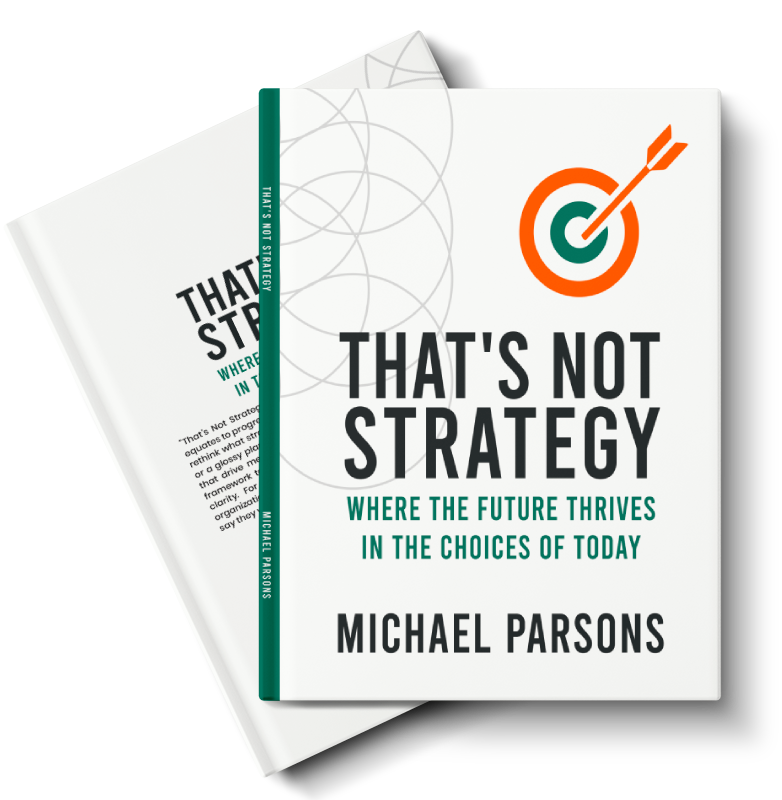
That’s Not Strategy

Where the Future Thrives in the Choices of Today
That’s Not Strategy confronts one of the most persistent failures in schools and organizations: mistaking plans, initiatives, and activity for strategy. Drawing on more than 25 years of international leadership experience, Michael Parsons argues that strategy is not a document, a timeline, or a collection of actions. Strategy is a disciplined set of choices about focus, priorities, trade-offs, and direction. When those choices are unclear, organizations drift. When they are deliberate, the future becomes designable. Through real-world leadership examples, reflective prompts, and practical frameworks, the book introduces the Bullseye Strategy Model, a way of aligning a school’s identity (WHO) and context (WHERE) with its WHY, HOW, and WHAT. Rather than encouraging leaders to do more, Parsons challenges them to do less with greater intention, creating coherence across culture, systems, and decision-making. Written for leaders tired of initiative overload and reactive planning, That’s Not Strategy is a call to move beyond busyness toward clarity, where strategy becomes a living guide for daily decisions rather than a static plan that gathers dust.

That’s Not Wisdom

Data Captures the Past. Wisdom Creates the Future.
In That’s Not Wisdom, Michael Parsons turns to one of the most misunderstood forces in modern leadership: data. Despite unprecedented access to dashboards, reports, and analytics, many organizations remain reactive, inconsistent, and uncertain in their decision-making. Parsons argues that the problem is not a lack of data, but a lack of data literacy and judgment. Data captures what has already happened. Wisdom is required to decide what should happen next. Building on the strategic foundations of That’s Not Strategy, this book reframes data as a leadership responsibility rather than a technical function. It challenges leaders to move beyond descriptive reporting and trend-spotting toward interpretation, meaning, and action. Through stories from schools, leadership reflections, and practical models, Parsons shows how data can serve empathy, equity, and impact rather than compliance and control. That’s Not Wisdom is written for leaders who want to stop asking what the data says and start asking what the data demands of them, ethically and strategically.

That’s Not Impact (In Progress)

Why Strategy Succeeds or Fails in the Hands of Leadership
That’s Not Impact completes the trilogy by addressing the most uncomfortable truth in organizational improvement: strategy and data do not create impact. Leadership does. This book explores why well-designed strategies stall, why data-informed decisions fail to change outcomes, and why improvement efforts lose momentum over time. Drawing on his work as a Deputy Head of School, accreditation reviewer, strategist, and coach, Michael Parsons examines how leadership behaviors, beliefs, and choices determine whether strategy lives or dies in practice. Central to the book is a reframing of the culture and strategy relationship. Parsons argues that culture does not replace strategy, nor does it consume it. Instead, culture is the healthy breakfast strategy needs to eat. It is the set of conditions that enables strategy to be executed with clarity, trust, and consistency. Without those conditions, even the strongest strategy starves. That’s Not Impact focuses on execution, accountability, coherence, and the human systems that sustain improvement over time. It is written for leaders ready to move beyond aspiration statements and frameworks and take responsibility for how strategy is experienced, enacted, and measured every day.

My Story

I have never experienced the world from a single place.
Over the course of my life, I have travelled to more than eighty countries and lived and worked across Canada, the United States, China, Vietnam, Namibia, Saudi Arabia, and now Indonesia. Each place has carried its own political realities, religious traditions, and cultural norms. None of them were interchangeable. All of them shaped who I am. Living internationally taught me early that context matters. What works in one system can fail entirely in another. What feels normal in one culture can feel confusing or even disrespectful in the next. That understanding now sits at the core of my thinking about leadership and strategy. There is no such thing as a universal solution. There is only thoughtful adaptation. One of the most formative experiences of my life happened in China, not in a classroom, but on the ice. I was coaching hockey, responsible for a team where none of the players spoke English. If I wanted them to succeed and if I wanted to eat, I had to adapt. I was not fluent in Chinese, but I learned enough to communicate, to connect, and to lead. That experience taught me something that has stayed with me ever since. Leadership is not about being understood. It is about doing the work required to understand others so they can succeed. I have learned some of my most important lessons far from formal leadership settings. I know I have made a good impression when someone invites me into their home, shares their food, their stories, and a piece of their everyday life, and makes me feel welcome. Across cultures, languages, and belief systems, that moment of shared humanity has always mattered more to me than titles or recognition. I am a very proud Canadian, and wherever I live in the world, I carry the values my family, friends, community, and country have instilled in me. Respect for others. Curiosity before judgment. Fairness. Humility. A belief that everyone deserves dignity and opportunity. These values guide how I lead, how I listen, and how I build trust in unfamiliar places. Movement has always been part of my life. I read. I write. I play softball and ice hockey. I race endurance cycling events and run a small fitness company. I travel the world with my bicycles, and it still amazes me where my pedals have taken me. Remote roads. Busy cities. Quiet conversations. Unexpected friendships. Cycling has taught me that progress is rarely linear, that endurance matters more than bursts of effort, and that drafting behind others requires trust while leading from the front requires responsibility. What stays with me most are the people. Students who challenged my assumptions. Teachers who trusted me when change felt uncomfortable. Leaders who modeled courage and humility. Communities that welcomed me as an outsider and taught me that belonging is never assumed. It is earned. Today, as an educational leader and author, my work focuses on helping schools and organizations move from reaction to intention. From plans to purpose. From data collection to wisdom. From strategy as an idea to strategy as lived experience. I believe deeply that leadership is not about control, but about clarity. Not about certainty, but about coherence. I am a nomad, always searching for the place that tells me I am home. Until then, I continue to learn, adapt, and reinvent myself, guided by the belief that real impact only happens when leaders are willing to meet people where they are and do the work required to help them succeed.